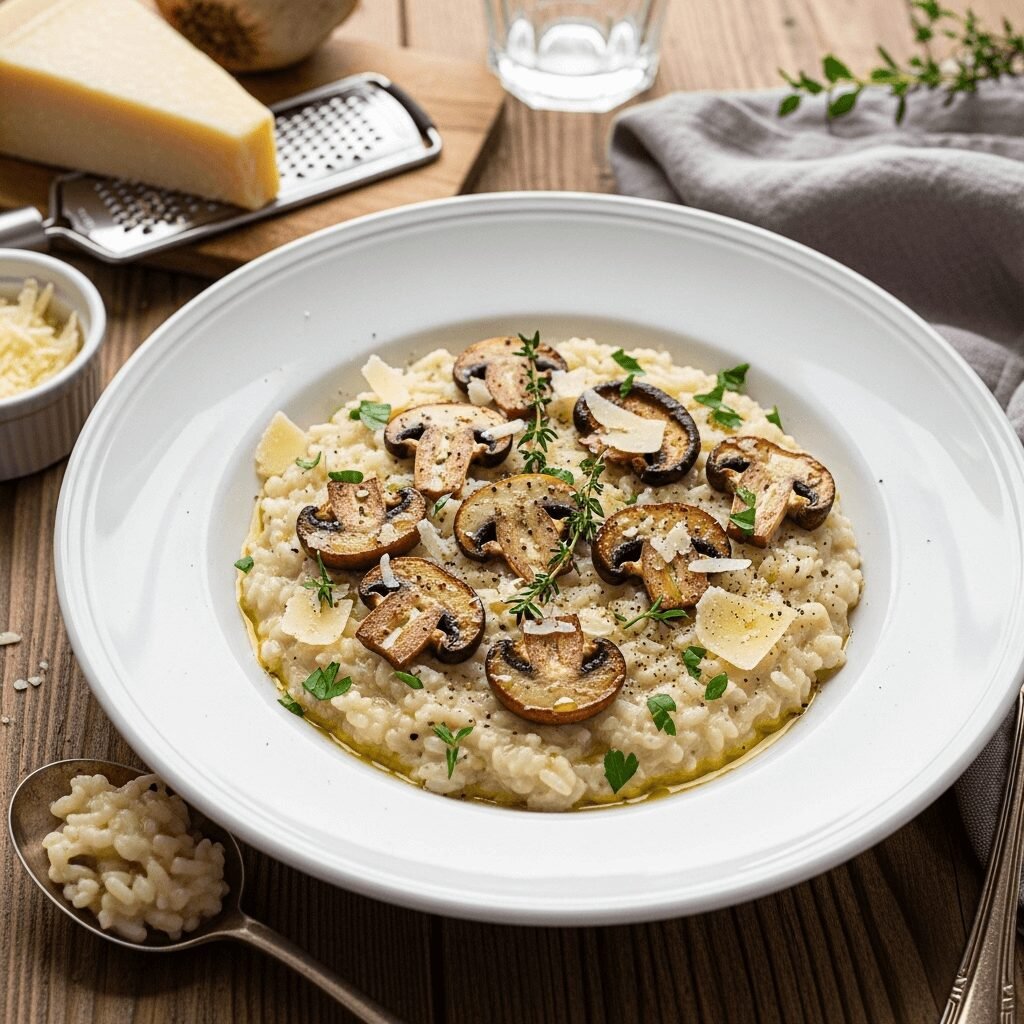
If you’ve ever dreamed of mastering that luxuriously creamy, restaurant-quality risotto that seems so intimidating but tastes absolutely divine, you’re in exactly the right place. This Creamy Mushroom Risotto is pure comfort in a bowl – tender Arborio rice cooked to silky perfection, infused with earthy mushrooms, rich Parmesan cheese, and just enough white wine to make it sophisticated. Each spoonful is velvety smooth, with rice that’s perfectly al dente and a sauce so creamy you won’t believe there’s barely any cream involved. It’s the kind of dish that makes you feel like a culinary genius when you serve it, yet it’s far more approachable than most people think.
What makes this risotto truly special is the technique of slowly adding warm broth and constantly stirring, which coaxes the starch out of the rice to create that signature creamy texture without relying on heavy cream. The mushrooms add an earthy, umami depth that pairs beautifully with the nutty Parmesan and subtle sweetness of the wine. This isn’t just rice – it’s a sophisticated dish that elevates any meal into something memorable.
This versatile recipe works beautifully in so many situations. Serve it as an elegant main course for date night at home, as a show-stopping side dish for holiday dinners, or even as a comforting weeknight meal when you want something special without leaving the house. It’s naturally vegetarian and gluten-free, making it perfect for entertaining guests with various dietary needs. While it does require about 30 minutes of active stirring, the meditative process is actually quite relaxing, and the spectacular results are absolutely worth every moment spent at the stove.
History / Background
Risotto holds a cherished place in Italian culinary history, particularly in Northern Italy where rice cultivation has flourished since the 15th century. The dish originated in the Po Valley region, where the climate and terrain proved perfect for growing short-grain rice varieties. Milan, Mantua, and Venice all claim to be the birthplace of various risotto styles, and the debate continues to this day among proud Italian cooks.
The most famous origin story involves a young glassmaker’s apprentice in 16th-century Milan who was working on the stained glass windows of the Duomo cathedral. He was known for adding saffron to glass pigments to achieve brilliant yellows. At his master’s daughter’s wedding in 1574, as a joke, he added saffron to the rice dish being served. The guests loved it, and thus “Risotto alla Milanese” was born – though this tale may be more legend than fact, it captures the spirit of Italian culinary innovation.
Mushroom risotto, or “Risotto ai Funghi,” has equally deep roots in Northern Italian cuisine. The regions of Piedmont, Lombardy, and Veneto are famous for their wild mushrooms, particularly porcini, which grow abundantly in the forests during autumn. For centuries, Italian families would forage for mushrooms and combine them with their rice for a hearty, satisfying meal that celebrated the season’s bounty. This combination of earthy mushrooms and creamy rice became a staple in Italian trattorias and home kitchens alike.
The technique of making risotto – the slow addition of liquid and constant stirring – developed over centuries as Italian cooks discovered this method released the rice’s natural starches, creating a creamy consistency without needing dairy. This cooking method transforms simple ingredients into something far greater than the sum of its parts, embodying the Italian philosophy of letting quality ingredients shine through thoughtful preparation.
Risotto gained international popularity in the 1980s and 1990s as Italian cuisine became fashionable in fine dining restaurants across Europe and America. What was once a humble peasant dish evolved into a sophisticated restaurant staple, with chefs creating countless variations. Today, mushroom risotto remains one of the most beloved versions, appreciated for its rich flavor, elegant appearance, and the comforting luxury it brings to any table.
Why You’ll Love This Recipe
This Creamy Mushroom Risotto is about to become your signature dish – the one you make when you want to impress dinner guests or treat yourself to something truly special. While it has a reputation for being difficult, this recipe breaks down the process into simple, manageable steps that guarantee success every time.
Here’s why this recipe deserves a place in your cooking repertoire:
- Restaurant-quality at home – Achieve that luxurious, creamy texture and sophisticated flavor that rivals any upscale Italian restaurant
- Naturally gluten-free – Perfect for those with gluten sensitivities or celiac disease without requiring any special substitutions
- Vegetarian-friendly – A satisfying meatless main course that’s substantial enough to please everyone at the table
- Surprisingly simple technique – While it requires attention, the actual cooking method is straightforward and repetitive, making it perfect for building confidence
- Impressive presentation – Looks elegant and sophisticated with minimal plating effort, making guests think you spent hours in the kitchen
- Customizable base – Once you master the basic technique, you can create endless variations with different ingredients
- Comforting and luxurious – That perfect combination of cozy comfort food and special occasion elegance
- No heavy cream needed – Achieves incredible creaminess through technique rather than loads of dairy
- Umami-rich flavor – The mushrooms provide deep, savory notes that satisfy on a profound level
- Perfect for date night – Romantic, delicious, and shows you put in effort without being overly complicated
- Great for entertaining – Can be partially prepared ahead, then finished while guests enjoy appetizers
- Teaches valuable skills – Mastering risotto builds fundamental cooking techniques useful for many other dishes
- Seasonal flexibility – Works year-round but especially satisfying in cooler months when you crave comfort food
Ingredient Notes
Understanding your ingredients is crucial for risotto success. Here’s everything you need to know about each component and how to choose the best quality.
Arborio Rice: This short-grain Italian rice is non-negotiable for authentic risotto. Arborio has a high starch content that creates the signature creamy texture when stirred. Each grain has a white dot in the center called the “pearl,” which helps it stay slightly firm (al dente) while the exterior becomes creamy. You’ll need 1½ cups for this recipe. Carnaroli or Vialone Nano rice are excellent alternatives if you can find them – they’re actually preferred by some Italian chefs for their superior texture. Never use long-grain rice like jasmine or basmati, as they won’t produce the same creamy result.
Mushrooms: A mix of mushrooms provides the best flavor complexity. Cremini (baby bella) mushrooms offer reliable flavor and texture, while shiitake add earthiness, and oyster mushrooms contribute delicate texture. Wild mushrooms like porcini, chanterelles, or morels are incredible if you can source them, but any combination of mushrooms works. You’ll need about 1 pound total, cleaned and sliced. Avoid pre-sliced mushrooms as they dry out quickly – always slice fresh mushrooms just before cooking.
Chicken or Vegetable Broth: High-quality broth is essential since it’s absorbed into every grain of rice. Use low-sodium broth so you can control the salt level. Homemade stock is ideal, but quality store-bought works perfectly. You’ll need 6-7 cups kept warm throughout cooking. Mushroom broth creates the most intense mushroom flavor for a fully vegetarian version.
White Wine: Dry white wine adds acidity and depth that balances the richness. Pinot Grigio, Sauvignon Blanc, or Chardonnay all work beautifully. Use something you’d actually drink – if you wouldn’t drink it, don’t cook with it. The alcohol cooks off, leaving just the flavor. In a pinch, you can substitute with additional broth plus a tablespoon of lemon juice, though wine provides superior flavor.
Parmesan Cheese: Real Parmigiano-Reggiano is worth the investment. Its nutty, complex flavor and perfect melting properties are irreplaceable. You’ll need about 1 cup freshly grated. Always buy a block and grate it yourself – pre-grated contains anti-caking agents that prevent proper melting. Pecorino Romano can substitute for a sharper, saltier flavor.
Butter: High-quality unsalted butter adds richness and helps create that glossy, luxurious finish. You’ll use it at the beginning for sautéing and at the end for the “mantecatura” – the final enrichment that makes risotto silky. European-style butter with higher fat content creates even more luxurious results.
Onion and Garlic: Finely diced yellow or white onion provides aromatic base flavor, while garlic adds depth. Shallots can replace onion for a more delicate, sophisticated flavor that many restaurant chefs prefer.
Fresh Herbs: Fresh thyme pairs beautifully with mushrooms, adding earthy, savory notes. Fresh parsley provides bright, fresh garnish. Italian flat-leaf parsley has more flavor than curly.
Olive Oil: Extra virgin olive oil for sautéing the vegetables and mushrooms provides fruity depth.
Equipment Needed
Having the right equipment makes the risotto-making process smoother and more enjoyable:
- Large, heavy-bottomed saucepan or Dutch oven – A 4-6 quart pot with thick bottom distributes heat evenly and prevents scorching. Wide is better than tall for easier stirring
- Medium saucepan – For keeping your broth warm throughout cooking
- Wooden spoon or silicone spatula – For the constant stirring; wood is traditional and won’t scratch your pan
- Sharp chef’s knife – For slicing mushrooms and dicing onions
- Cutting board – Preferably separate boards for vegetables
- Ladle – For adding broth one ladleful at a time (about ¾ cup per ladle)
- Measuring cups and spoons – For accurate ingredient measurements
- Box grater – For freshly grating Parmesan cheese
- Kitchen timer – Helpful for tracking cooking time
- Clean kitchen towel – For cleaning mushrooms (avoid washing them)
- Tasting spoon – For checking seasoning throughout cooking

Creamy Mushroom Risotto Recipe
- Total Time: 50 minutes
- Yield: 4-6 servings 1x
- Diet: Gluten Free
Description
This Creamy Mushroom Risotto is the ultimate comfort food – silky, luxurious Arborio rice cooked with earthy mushrooms, white wine, and Parmesan cheese. Restaurant-quality results at home with straightforward technique!
Ingredients
For the Risotto:
- 1½ cups Arborio rice
- 6-7 cups low-sodium chicken or vegetable broth
- 1 pound mixed mushrooms (cremini, shiitake, oyster), cleaned and sliced
- 1 medium yellow onion, finely diced
- 3 cloves garlic, minced
- ¾ cup dry white wine
- 1 cup Parmigiano-Reggiano cheese, freshly grated (plus extra for serving)
- 4 tablespoons unsalted butter (divided)
- 2 tablespoons olive oil
- 2 teaspoons fresh thyme leaves (or 1 teaspoon dried)
- Salt and freshly ground black pepper to taste
- 2 tablespoons fresh parsley, chopped (for garnish)
Optional Additions:
- 1 tablespoon truffle oil for finishing (luxury upgrade!)
- ½ cup heavy cream for extra richness
- Splash of lemon juice for brightness
Instructions
- Warm the Broth: Pour the chicken or vegetable broth into a medium saucepan and bring to a gentle simmer over medium-low heat. Keep it warm throughout the cooking process – adding cold broth would shock the rice and interrupt the cooking. Reduce to lowest heat to maintain warmth without evaporating.
- Prepare the Mushrooms: Clean mushrooms with a damp towel or mushroom brush – don’t wash them as they absorb water. Slice them about ¼-inch thick. Set aside a handful of the prettiest slices for garnish if desired.
- Sauté the Mushrooms: In your large, heavy-bottomed saucepan, heat 1 tablespoon olive oil and 1 tablespoon butter over medium-high heat. Add the mushrooms and cook without stirring for 2-3 minutes to develop golden-brown color. Then stir and continue cooking for 5-7 minutes total until the mushrooms are golden and any liquid has evaporated. Season with salt and pepper. Remove mushrooms to a plate and set aside.
- Sauté the Aromatics: In the same pan, add remaining tablespoon of olive oil and 1 tablespoon butter over medium heat. Add the diced onion and cook for 3-4 minutes until soft and translucent but not browned. Add minced garlic and thyme, cooking for 30 seconds until fragrant.
- Toast the Rice: Add the Arborio rice to the pan with the onions. Stir constantly for 2-3 minutes until the rice grains are coated with oil and butter, and the edges become slightly translucent. This toasting step is crucial for texture and helps the grains maintain their shape. You should hear a slight crackling sound.
- Add the Wine: Pour in the white wine and stir constantly until it’s almost completely absorbed by the rice, about 2-3 minutes. The alcohol will cook off, leaving just the flavor. The pan will release aromatic steam – breathe it in!
- Begin Adding Broth: Using a ladle, add one ladleful (about ¾ cup) of warm broth to the rice. Stir frequently until the liquid is almost completely absorbed. The rice should be at a gentle simmer, not a rapid boil. Adjust heat if needed.
- Continue the Rhythm: Continue adding broth one ladleful at a time, stirring frequently and allowing each addition to be absorbed before adding the next. This process will take about 20-25 minutes total. You don’t need to stir constantly every second, but you should stir every 30-60 seconds and never walk away from the pot for long.
- Add the Mushrooms Back: After about 15 minutes, when the rice is halfway cooked, stir in the sautéed mushrooms (except your reserved garnish mushrooms). This allows their flavors to meld with the rice.
- Test for Doneness: After 20-25 minutes of adding broth, start tasting the rice. It should be al dente – tender but with a slight firmness in the center, never mushy or chalky. The risotto should be creamy and flow slowly when you spoon it onto a plate (all’onda, meaning “like a wave”).
- Finish with Mantecatura: Remove from heat. Stir in the remaining 2 tablespoons butter and the grated Parmesan cheese vigorously. This final enrichment creates incredible creaminess and glossy texture. Taste and adjust seasoning with salt and pepper. If the risotto seems too thick, stir in a bit more warm broth.
- Serve Immediately: Spoon risotto into shallow bowls. Garnish with reserved sautéed mushrooms, extra grated Parmesan, chopped fresh parsley, and freshly cracked black pepper. Drizzle with truffle oil if using. Serve immediately while hot and creamy – risotto waits for no one!
Notes
- Stirring Frequency: You don’t need to stir constantly without stopping, but frequent stirring (every 30-60 seconds) is important to release starch and prevent sticking.
- Broth Amount: You may not need all the broth, or you might need slightly more. It depends on your rice, heat level, and pan size. Keep extra broth warm just in case.
- Timing: Total cooking time from first broth addition to done is typically 25-30 minutes. Don’t rush by adding broth too quickly or cooking at too high heat.
- Consistency: Risotto should be creamy and slightly loose, not stiff. It will thicken as it sits.
- Fresh Parmesan Only: Pre-grated Parmesan won’t melt properly – always grate fresh from a block.
- Wine Substitute: If avoiding alcohol, use extra broth plus 1 tablespoon lemon juice for acidity.
- Prep Time: 15 minutes
- Cook Time: 35 minutes
- Category: Main Course / Side Dish
- Method: Stovetop
- Cuisine: Italian
Nutrition
- Serving Size: About 1½ cups (1/4 of recipe as main course)
- Calories: 445
- Sugar: 4g
- Sodium: 650mg
- Fat: 18g
- Saturated Fat: 9g
- Unsaturated Fat: 8g
- Trans Fat: 0g
- Carbohydrates: 54g
- Fiber: 3g
- Protein: 15g
- Cholesterol: 35mg
Nutrition information is approximate and will vary based on specific ingredients used and portion sizes. Nutritional values are for the risotto as a main course serving.
Tips & Variations
Once you’ve mastered the basic technique, risotto becomes a canvas for endless creativity. Here are some delicious ways to customize this recipe:
Truffle Mushroom Risotto: Add 1-2 tablespoons truffle oil at the end for luxurious, earthy aroma. Use a combination of wild mushrooms for maximum impact. Shave fresh truffle over the top if you’re feeling extravagant.
Creamy Porcini Risotto: Rehydrate ½ cup dried porcini mushrooms in warm water for 20 minutes. Use the soaking liquid (strained) as part of your broth for intense mushroom flavor. Chop the rehydrated porcini and add with fresh mushrooms.
Lemon Herb Risotto: Add the zest of one lemon with the final butter and Parmesan. Stir in 2 tablespoons fresh lemon juice and plenty of fresh basil, parsley, or dill for bright, fresh flavors.
Protein Additions: Stir in cooked, diced chicken breast, pan-seared scallops, crispy pancetta, or grilled shrimp in the last few minutes for a heartier meal.
Asparagus Mushroom Risotto: Add 1 pound asparagus cut into 1-inch pieces. Blanch asparagus separately, then stir in during the last 5 minutes of cooking for spring-inspired version.
Saffron Mushroom Risotto: Add a pinch of saffron threads (soaked in 2 tablespoons warm broth) with the wine for golden color and subtle floral flavor – a nod to classic Risotto Milanese.
Vegan Version: Use vegetable broth, replace butter with vegan butter or extra olive oil, and substitute nutritional yeast (about ½ cup) for Parmesan. It won’t be quite as creamy but still delicious.
Butternut Squash and Mushroom: Roast 2 cups cubed butternut squash and stir in with the mushrooms for autumn-inspired sweetness that complements the earthy mushrooms.
Four Cheese: Create an ultra-decadent version with a mix of Parmesan, fontina, Gorgonzola, and mascarpone stirred in at the end.
Pro Chef Tips
These professional techniques will elevate your risotto from homemade to restaurant-quality:
The Toasting Step is Sacred: Don’t skip toasting the rice in oil and butter before adding liquid. This coats each grain and helps it maintain structure while becoming creamy. Toast until you see translucent edges and smell a slightly nutty aroma – about 2-3 minutes.
Wine Quality Matters: Use a wine you’d actually enjoy drinking. The flavor concentrates as it reduces, so poor-quality wine will make your risotto taste harsh or acidic. Let the wine fully absorb before adding broth – this cooks off the alcohol while leaving the flavor.
Warm Broth is Non-Negotiable: Cold broth shocks the rice and stops the cooking process, resulting in uneven texture. Keep your broth at a gentle simmer throughout. This also speeds up cooking since you’re not waiting for cold liquid to heat up each time.
The Right Simmer: Your risotto should bubble gently but persistently. Too high heat and the outside of the rice will overcook before the inside is done. Too low and you’ll be stirring for an hour. Find that sweet spot where it bubbles steadily but not violently.
Stir with Purpose: You’re not just moving rice around – you’re coaxing starch out of the grains to create creaminess. Use a wooden spoon or silicone spatula and make sure to scrape the bottom and sides of the pan with each stir.
Taste Constantly: Professional chefs taste risotto multiple times during cooking. Start tasting after 18 minutes to track the rice’s texture progression. You’re looking for grains that have a slight resistance in the very center but are tender throughout.
The Wave Test: Perfect risotto should slowly flow across the plate like a wave (all’onda in Italian) when you tilt it. If it sits in a stiff mound, it’s too thick – add more broth. If it runs like soup, you added too much liquid.
Mantecatura Technique: The final addition of butter and Parmesan (mantecatura) should be vigorous and enthusiastic. Remove from heat and stir energetically for 30-60 seconds to emulsify the fat and create that glossy, luxurious finish.
Rest Briefly: Let the risotto rest off-heat for 1-2 minutes after the final stir. This allows the starches to settle and flavors to meld. Cover loosely but don’t let it sit more than 3-4 minutes or it will become too thick.
Common Mistakes to Avoid
Even experienced cooks can stumble with risotto. Here’s how to sidestep the most common pitfalls:
Adding Broth Too Quickly: This is the number one mistake. If you dump in multiple ladles of broth at once, you end up with soupy rice that never develops proper creaminess. The rice needs time to release its starch between additions. Each ladleful should be mostly absorbed before adding the next. Be patient – the slow process is what creates magic.
Using Cold Broth: Adding cold broth dramatically lowers the pan temperature and shocks the rice, resulting in uneven cooking and a longer overall cooking time. Some grains will be mushy while others remain hard. Always keep your broth warm on a neighboring burner. This one step makes a massive difference in final texture.
Not Stirring Enough: While you don’t need to stir every single second without stopping, infrequent stirring causes two problems: the rice sticks and burns on the bottom, and not enough starch releases to create creaminess. Aim to stir every 30-60 seconds throughout cooking. Set a timer if you tend to get distracted.
Overcooking the Rice: Mushy, porridge-like risotto has lost all its character. The rice should be al dente – tender but with slight firmness in the very center when you bite it. Start tasting at 20 minutes and remove from heat as soon as it reaches the right texture. Remember it will continue cooking slightly from residual heat.
Using the Wrong Rice: Long-grain rice like basmati or jasmine will never create proper risotto no matter how perfectly you execute the technique. These rice varieties don’t contain enough starch. You must use short-grain Italian rice – Arborio, Carnaroli, or Vialone Nano. There are no successful substitutions.
Skipping the Final Butter and Cheese: Some home cooks think they can make the dish lighter by omitting the final enrichment. This mantecatura step is essential for creating that signature creamy, glossy finish. Without it, your risotto will be grainy and dry rather than luxurious. The small amount of butter and cheese makes all the difference.
Storage & Meal Prep
While risotto is absolutely best served immediately, there are ways to handle leftovers and partial prep-ahead strategies:
Refrigerator Storage: Cool leftover risotto completely, then transfer to an airtight container. Store in the refrigerator for up to 3 days. The risotto will thicken and dry out considerably as the rice continues absorbing liquid and the starches firm up. This is normal.
Reheating Refrigerated Risotto: The best method is on the stovetop. Transfer risotto to a saucepan and add ¼-½ cup warm broth or water. Heat over medium-low, stirring frequently, until warmed through and creamy consistency returns. You can also microwave in 1-minute intervals at 50% power, adding liquid and stirring between each interval. The texture won’t be identical to fresh, but it’s still delicious.
Transforming Leftovers: Cold risotto is perfect for making arancini (Italian rice balls). Form into balls, stuff with mozzarella if desired, coat in breadcrumbs, and fry until golden. You can also make risotto cakes: form into patties and pan-fry in butter until crispy on both sides.
Meal Prep Considerations: Risotto doesn’t meal prep well in its traditional form since the texture deteriorates. However, you can prep components: slice mushrooms, dice onions, and grate cheese up to 2 days ahead. Measure out your rice. When ready to cook, you’ll have everything ready and cooking will go faster.
Make-Ahead & Freezer Notes
Risotto’s reputation as a last-minute dish isn’t entirely true – there are strategic ways to prep ahead:
Partial Pre-Cooking Method: Cook the risotto about halfway through (after adding about half the broth). Spread it on a baking sheet to cool quickly, then refrigerate up to 24 hours. When ready to serve, return to the pan with warm broth and finish cooking. Restaurant chefs use this technique for service.
Pre-Cooked Components: Sauté the mushrooms, onions, and garlic up to 2 days ahead. Store refrigerated in airtight containers. Warm broth can be prepared and kept warm in a slow cooker on lowest setting if entertaining.
Freezing Cooked Risotto: While not ideal, you can freeze risotto for up to 1 month. Cool completely, portion into freezer bags removing all air, and freeze flat. The texture will be softer and less creamy when reheated, but it’s better than letting leftovers go bad. Thaw overnight in refrigerator, then reheat gently with additional broth.
Freezing Raw Components: Sliced mushrooms don’t freeze well (they become watery), but you can freeze homemade stock for up to 3 months. Always have quality stock in your freezer for spontaneous risotto making.
Best Reheating Method: For frozen risotto, thaw overnight in refrigerator. Reheat in a saucepan over medium-low heat with ½ cup warm broth, stirring frequently until hot and creamy. You may need to add more liquid than you expect since frozen and reheated risotto absorbs a lot.
Managing Dinner Party Timing: If entertaining, use the partial pre-cooking method. Cook risotto halfway while guests enjoy appetizers, then finish it fresh so everyone experiences risotto at its peak while still hot and creamy from the stove.
Serving Suggestions
This versatile risotto works as either a main course or sophisticated side dish, pairing beautifully with many foods:
As a Main Course: Serve generous portions (about 1½-2 cups per person) in shallow bowls with a simple green salad dressed in lemon vinaigrette. Add crusty Italian bread for soaking up every bit of creamy goodness. A glass of the same white wine used in cooking makes perfect pairing.
As a Side Dish: Smaller portions (about 1 cup) pair elegantly with osso buco (the classic pairing), roasted chicken, pan-seared pork chops, grilled lamb chops, or beef tenderloin. The creamy richness complements roasted or grilled proteins beautifully.
Vegetable Additions: Serve alongside roasted asparagus, sautéed spinach, or a arugula salad with shaved Parmesan and lemon dressing. Green vegetables cut through the richness while adding color and nutrition.
Italian Feast: Make it part of a multi-course Italian dinner. Start with antipasti (prosciutto, olives, marinated vegetables), serve the risotto as primi (first course), follow with a protein secondi (second course), and finish with simple dessert like panna cotta or tiramisu.
Wine Pairings: The same wine used in cooking makes an excellent pairing. Pinot Grigio, Chardonnay, or Sauvignon Blanc all complement the earthy mushrooms and creamy texture. For red wine lovers, try a light Pinot Noir that won’t overpower the delicate flavors.
Bread Service: Serve with warm, crusty bread for texture contrast. Garlic bread, focaccia, or simple Italian bread all work wonderfully. The bread is perfect for enjoying any risotto that clings to the bowl.
Garnish Ideas: Beyond parsley and Parmesan, consider crispy fried sage leaves, microgreens, additional sautéed mushrooms artfully arranged on top, or a drizzle of aged balsamic vinegar for restaurant-style presentation.
Seasonal Serving: In fall and winter, this makes perfect comfort food. In spring, add fresh peas and asparagus. Summer versions can incorporate fresh tomatoes and basil.
FAQs Section
Can I make risotto without wine?
Yes, absolutely! While wine adds acidity and depth that elevates the dish, you can make delicious risotto without it. Simply replace the wine with an equal amount of broth plus 1 tablespoon of fresh lemon juice or white wine vinegar to provide the acidity that balances the richness. The flavor will be slightly different but still excellent. Some cooks use a splash of vermouth as a wine alternative, or simply use all broth for a straightforward, alcohol-free version.
Do I really need to stir constantly?
The short answer is no – you don’t need to stir every single second without stopping. However, frequent stirring (every 30-60 seconds) is important for two reasons: it prevents the rice from sticking and burning on the bottom of the pan, and it agitates the grains to release their starch, which creates that signature creaminess. You can step away briefly to prep garnishes or take a sip of wine, but don’t leave the stove for extended periods. The stirring is meditative and actually quite relaxing once you get into the rhythm.
Why is my risotto gummy or gluey?
Gummy risotto usually results from one of three mistakes: using the wrong type of rice (long-grain rice becomes gummy), adding too much liquid too quickly without letting each addition absorb properly, or over-stirring too vigorously which breaks the rice grains and releases too much starch. To avoid this, always use Arborio, Carnaroli, or Vialone Nano rice, add broth gradually one ladle at a time, and stir gently but frequently rather than aggressively beating the rice.
Can I use any type of mushrooms?
Most mushrooms work wonderfully in risotto! Cremini (baby bella) and white button mushrooms are reliable and affordable. Shiitake add earthy depth, while oyster mushrooms contribute delicate texture. Wild mushrooms like porcini, chanterelles, morels, or hen of the woods create the most spectacular flavor if you can find them. A mix of varieties provides the most complex flavor profile. Avoid watery mushrooms like portobello caps unless you remove the gills first. For maximum mushroom flavor, add dried porcini that have been rehydrated, and use the strained soaking liquid as part of your broth.
How do I know when risotto is perfectly cooked?
Perfect risotto requires both texture and consistency checks. For texture, taste a grain – it should be tender throughout but with a slight firmness in the very center (al dente), never mushy or chalky. For consistency, the risotto should flow slowly across a tilted plate like a wave, neither sitting in a stiff mound nor running like soup. It should look creamy and glossy, with individual grains visible but surrounded by a creamy sauce. This typically takes 25-30 minutes of adding broth after the wine has been absorbed. Start tasting at 20 minutes and don’t be afraid to remove from heat as soon as it reaches the right texture – it will continue cooking slightly from residual heat.
Can I make risotto ahead of time for a dinner party?
Traditional risotto is best served immediately, but restaurant chefs use a clever trick for dinner service: cook the risotto about halfway through (after adding roughly half the broth), then spread it on a baking sheet to cool quickly. Refrigerate up to 24 hours. When guests arrive, reheat gently and finish cooking with the remaining broth. This method saves you from stirring for 30 minutes while guests wait, while still serving fresh, creamy risotto at its peak. The texture won’t be 100% identical to completely fresh, but it’s very close and far better than fully pre-cooked risotto.
Why does my risotto turn out too thick or too soupy?
Consistency issues usually stem from not adjusting the liquid properly. Too thick means you didn’t add enough broth – risotto should be slightly loose and creamy, not stiff. If this happens, simply stir in more warm broth a few tablespoons at a time until it reaches the right consistency. Remember that risotto thickens as it sits, so it should be slightly looser than you want when you first plate it. Too soupy means you added too much liquid too quickly, or didn’t let each addition absorb properly before adding more. The fix is to continue cooking uncovered, stirring frequently, until excess liquid evaporates. In the future, add broth more gradually and patiently.
Conclusion
And there you have it – everything you nee
d to create the most spectacular, restaurant-quality Creamy Mushroom Risotto right in your own kitchen! This recipe proves that what seems intimidating at first is actually an incredibly rewarding cooking experience that builds fundamental skills and confidence. Yes, it requires your attention for about 30 minutes, but that time spent stirring at the stove is surprisingly meditative and therapeutic, and the luxurious results are absolutely worth every moment.
What I love most about mastering risotto is how it opens up a whole world of possibilities. Once you’ve nailed this mushroom version, you can apply the same technique to create endless variations – butternut squash and sage for fall, asparagus and lemon for spring, seafood risotto for special occasions, or whatever seasonal ingredients inspire you. It’s a foundational skill that serves you for a lifetime, and one that never fails to impress everyone lucky enough to share your table.
The beauty of this dish is how it manages to be both comforting and elegant, casual enough for a cozy weeknight at home yet sophisticated enough for the most important dinner parties. There’s something deeply satisfying about transforming simple ingredients – rice, mushrooms, broth, cheese – into something so creamy, luxurious, and utterly delicious through nothing more than technique and patience. It’s cooking at its most fundamental and most magical.
I absolutely can’t wait to hear how your Creamy Mushroom Risotto turns out! Did you use wild mushrooms from the farmers market? Add truffle oil for extra luxury? Make it for date night at home? Maybe you discovered your own secret technique for perfect risotto? Drop a comment below and share your experience – I genuinely love hearing from readers and learning what worked, what surprised you, and how you made this recipe your own. And if this becomes your go-to impressive dinner (which I’m confident it will), please save it to your Pinterest boards so you can find it easily next time you want to feel like a culinary genius, and help other home cooks discover the joy of homemade risotto!
Now grab that Arborio rice, pour yourself a glass of the white wine you’ll be cooking with, put on some relaxing music, and get ready to create some serious Italian magic. Your kitchen is about to smell absolutely incredible, and your taste buds are in for a treat. Happy cooking, friends!